Abdominoplasty (Tummy Tuck)
Personalised abdominal surgery designed to remove excess skin and, where required, repair separated abdominal muscles.
Abdominoplasty, also known as a tummy tuck, is a surgical procedure that removes excess abdominal skin and fat and may also repair separation of the abdominal muscles.
Changes to the abdomen can occur following pregnancy, significant weight loss, ageing or changes in skin elasticity. In some patients, the skin and abdominal wall do not return to their previous position despite weight stability, exercise or rehabilitation.
During surgery, excess tissue is removed and the abdominal skin is redraped. Where rectus diastasis, or separation of the abdominal muscles, is present, the abdominal wall may also be repaired as part of the procedure.
Dr Katie-Beth Webster will assess your skin, abdominal wall, fat distribution, previous scars and treatment goals before recommending an approach tailored to your anatomy.
What is an abdominoplasty?
Is abdominoplasty right for me?
Abdominoplasty may be considered if you have:
loose or overhanging abdominal skin
excess skin following pregnancy or significant weight loss
separation of the abdominal muscles
localised abdominal tissue that is not adequately addressed through weight loss alone
changes around the lower abdomen that affect comfort, movement or clothing
concerns about abdominal contour despite being at a relatively stable weight
It is not a substitute for weight loss, and significant future weight change or pregnancy may affect the result. Patients are generally best assessed once their weight is relatively stable.
During consultation, Dr Webster will determine whether your concern is primarily related to excess skin, fat, muscle separation or a combination of these factors.
What you can expect
Every abdominoplasty is planned according to the amount of excess skin, the condition of the abdominal wall and the patient’s individual anatomy. Understanding the consultation, surgery and recovery process can help you prepare for the procedure and establish realistic expectations.
-
Your consultation begins with a discussion about the changes you have noticed, any symptoms associated with abdominal muscle separation and what you would like surgery to achieve.
Dr Webster will assess:
the amount and location of excess skin
abdominal muscle separation
fat distribution
the position and shape of the umbilicus
existing scars, including caesarean scars
abdominal wall or hernia concerns
your weight and recent weight changes
Your medical history, medications, smoking status and future pregnancy plans will also be reviewed.
Dr Webster will explain whether a full or more limited abdominoplasty may be appropriate, whether muscle repair is required and the position and extent of the expected scars.
-
Abdominoplasty is generally performed under general anaesthesia.
A low horizontal incision is usually placed across the lower abdomen. Its length depends on the amount of excess skin requiring removal and may extend from hip to hip in a full abdominoplasty.
The abdominal skin and tissue are lifted, and excess skin and fat are removed. Where rectus diastasis is present, the abdominal wall can be repaired with internal sutures.
In a full abdominoplasty, the umbilicus is generally brought through a new opening in the redraped abdominal skin while remaining attached to its underlying stalk. Drains may also be used temporarily depending on the surgical approach.
-
Swelling, bruising, tightness and discomfort are expected during the early recovery period.
The current page advises that a hospital stay of around one to two nights is typical, with walking encouraged soon after surgery. A compression garment is generally worn during recovery.
Patients usually need to move carefully at first because the abdomen can feel tight. Activity is gradually increased as healing progresses, while heavy lifting, strenuous exercise and core training need to be avoided for several weeks. Healthdirect advises avoiding strain on the wounds for at least six weeks, while Katie’s current guidance indicates around six to eight weeks before heavy lifting or core exercise.
The abdominal contour becomes clearer as swelling resolves, while scars continue to mature over many months.
Why choose Dr Katie-Beth Webster?
As a specialist plastic surgeon, Dr Katie-Beth Webster provides detailed assessment and individualised planning for abdominoplasty surgery.
She will assess the abdominal skin, fat distribution and underlying abdominal wall before explaining the surgical approach most appropriate for your anatomy.
Where muscle separation is present, this can also be evaluated as part of the treatment plan.
Dr Webster will discuss the expected scars, recovery, benefits, limitations and potential risks so that you can make a properly informed decision about surgery.
Considering abdominoplasty?
A consultation with Dr Katie-Beth Webster can help determine whether excess skin, abdominal muscle separation or other tissue changes are contributing to your concerns and which surgical approach may be appropriate.
Dr Katie-Beth Webster provides compassionate, evidence-based care tailored to every patient's individual journey. Dr Katie-Beth Webster offers abdominoplasty consultations in Melbourne, with appointments available in Box Hill and East Melbourne.
Common questions about abdominoplasty
-
A full abdominoplasty generally addresses excess skin across the lower abdomen and may also treat tissue above the umbilicus. It commonly includes repositioning of the umbilicus and can incorporate repair of abdominal muscle separation.
A mini abdominoplasty is more limited and primarily addresses excess skin below the umbilicus. It typically requires a shorter incision and may involve less extensive treatment of the abdominal wall.
A mini procedure is not simply a smaller version chosen because recovery sounds easier. The appropriate technique depends on where your excess skin and muscle separation are located.
Dr Webster will assess the entire abdomen before recommending which approach is suitable.
-
Abdominoplasty and liposuction treat different concerns.
Liposuction removes localised fat but does not remove significant loose skin or repair separated abdominal muscles.
Abdominoplasty removes excess skin and may repair rectus diastasis. Liposuction may sometimes be combined with abdominoplasty where localised fat also contributes to the abdominal contour.
Where skin elasticity is good and excess fat is the primary concern, liposuction alone may be more appropriate.
-
Yes. Where rectus diastasis is present, the separated abdominal muscles may be brought together and supported with sutures during abdominoplasty.
Not every patient undergoing abdominoplasty requires muscle repair. Dr Webster will assess the abdominal wall and determine whether separation is present and whether repair is appropriate.
-
Medicare does not cover abdominoplasty performed purely for cosmetic reasons. However, some reconstructive procedures may qualify for an MBS item where specific clinical criteria are met.
For example, current Medicare item 30175 may apply to eligible patients with pregnancy-related rectus diastasis where the required clinical criteria are satisfied, including documented muscle separation and symptoms that have not responded adequately to conservative treatment.
Dr Webster can assess whether your circumstances may meet the relevant criteria, although eligibility should not be assumed before assessment.
-
A full abdominoplasty usually requires a low horizontal scar across the lower abdomen, commonly extending between the hips.
Dr Webster positions the incision as low as practical so it can generally be concealed beneath underwear or swimwear. A separate scar around the umbilicus is also usually required in a full abdominoplasty.
-
Future pregnancy can stretch the abdominal skin and muscles again and may affect the result of abdominoplasty.
For this reason, patients who are planning another pregnancy may be advised to delay surgery.
This does not mean pregnancy after abdominoplasty is impossible, but your future plans should be discussed with Dr Webster when considering the timing of surgery.
-
During a full abdominoplasty, the umbilicus usually remains attached to the abdominal wall on its existing stalk.
After the surrounding abdominal skin has been repositioned, a new opening is created so the umbilicus can be brought through at an appropriate position.
This results in a scar around the umbilicus as well as the lower abdominal scar.
A mini abdominoplasty may not require repositioning of the umbilicus, depending on the amount and location of skin being treated.
-
![]()
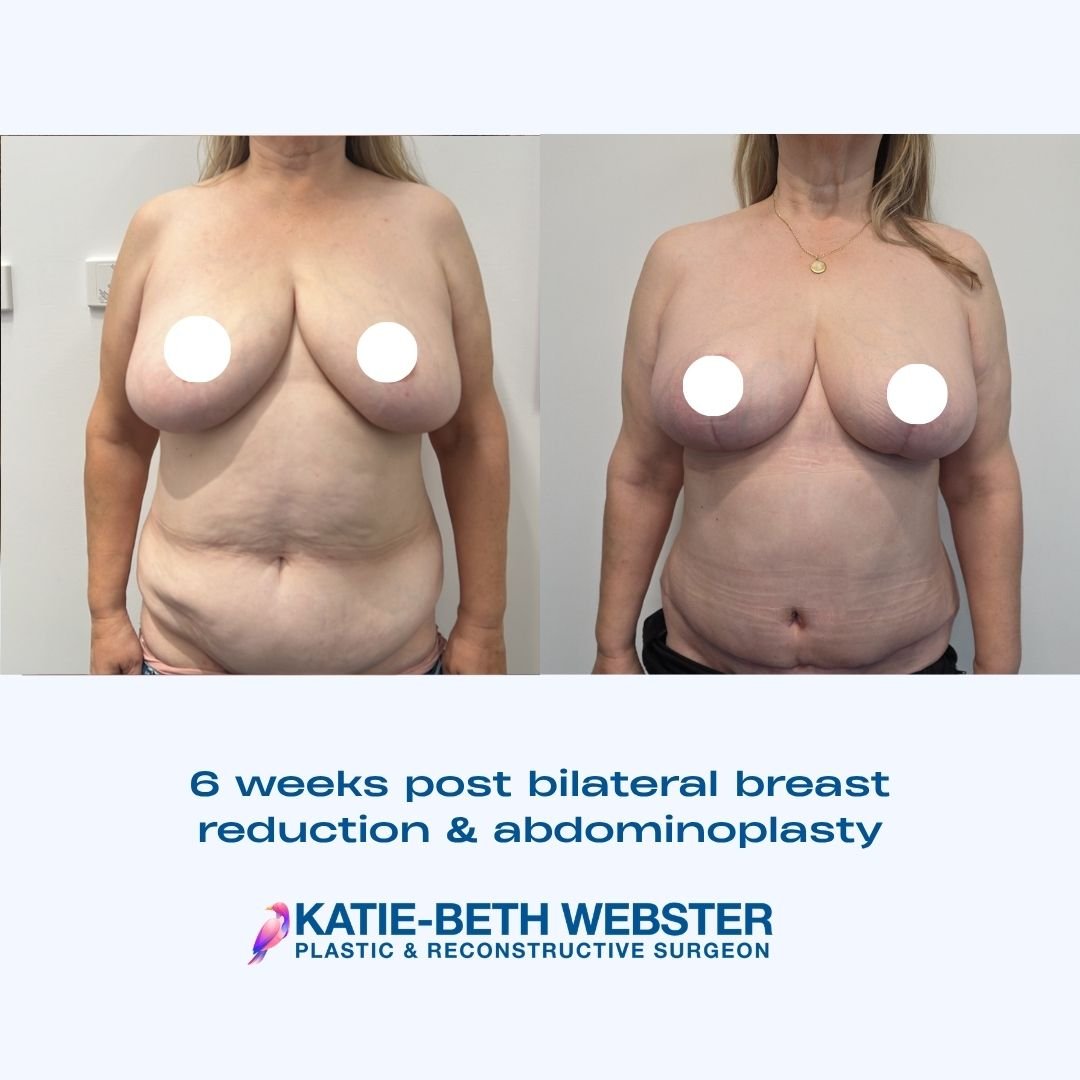
Bilateral Breast Reduction & Abdominoplasty
-
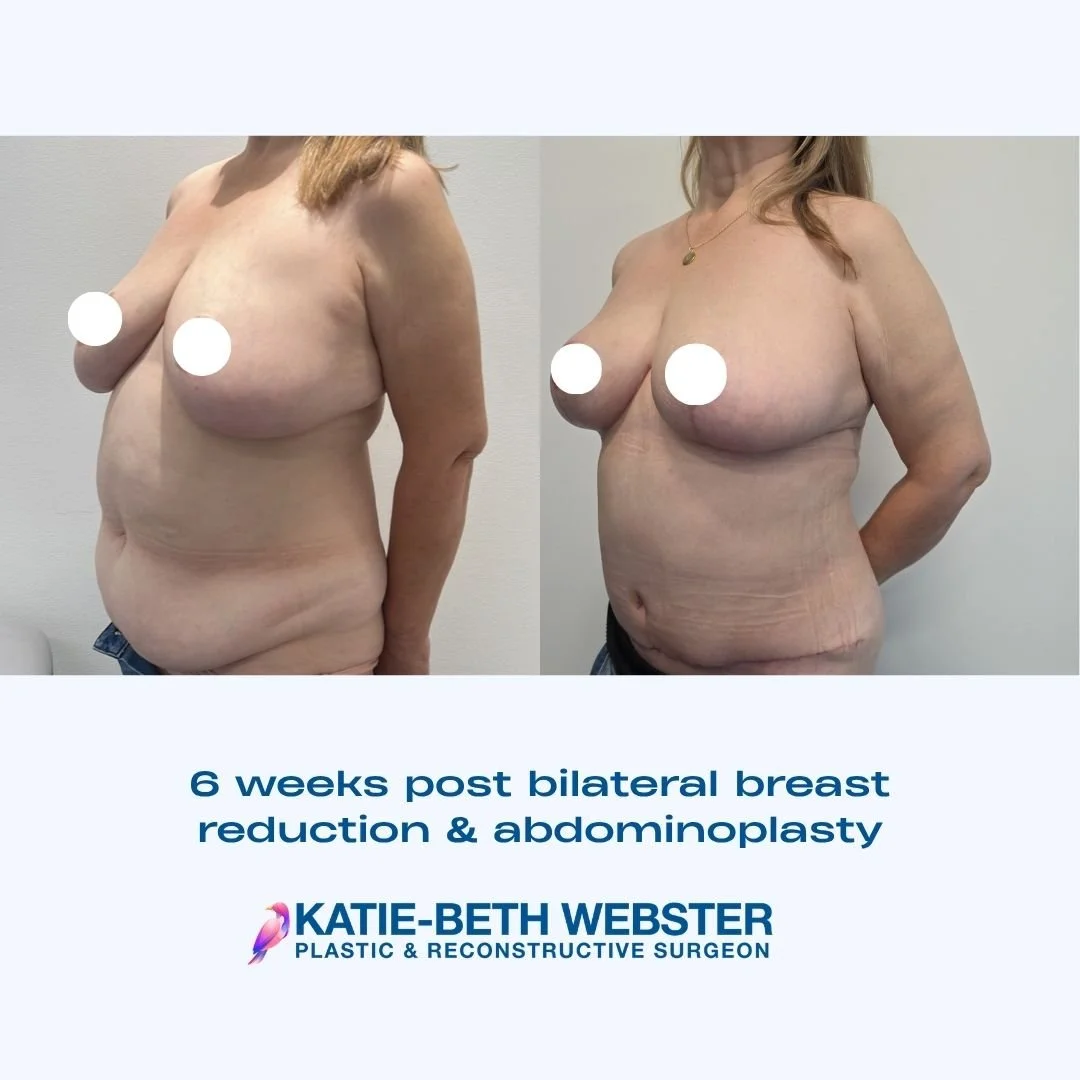
![Side-by-side comparison of a woman before and after bilateral breast reduction and abdominoplasty, six weeks post-surgery, showing reduced breast size and a flatter abdomen.]()
Bilateral Breast Reduction & Abdominoplasty